

Parameter definitions
The parameters your catalogue knows: type, unit, example values, and the context handed to the AI.
This is the parameter list — the properties your catalogue knows about at all. Until a parameter is here, nothing can be mapped onto it, nothing can be filled in for it, and nothing can be filtered by it. It is the first step of normalisation.
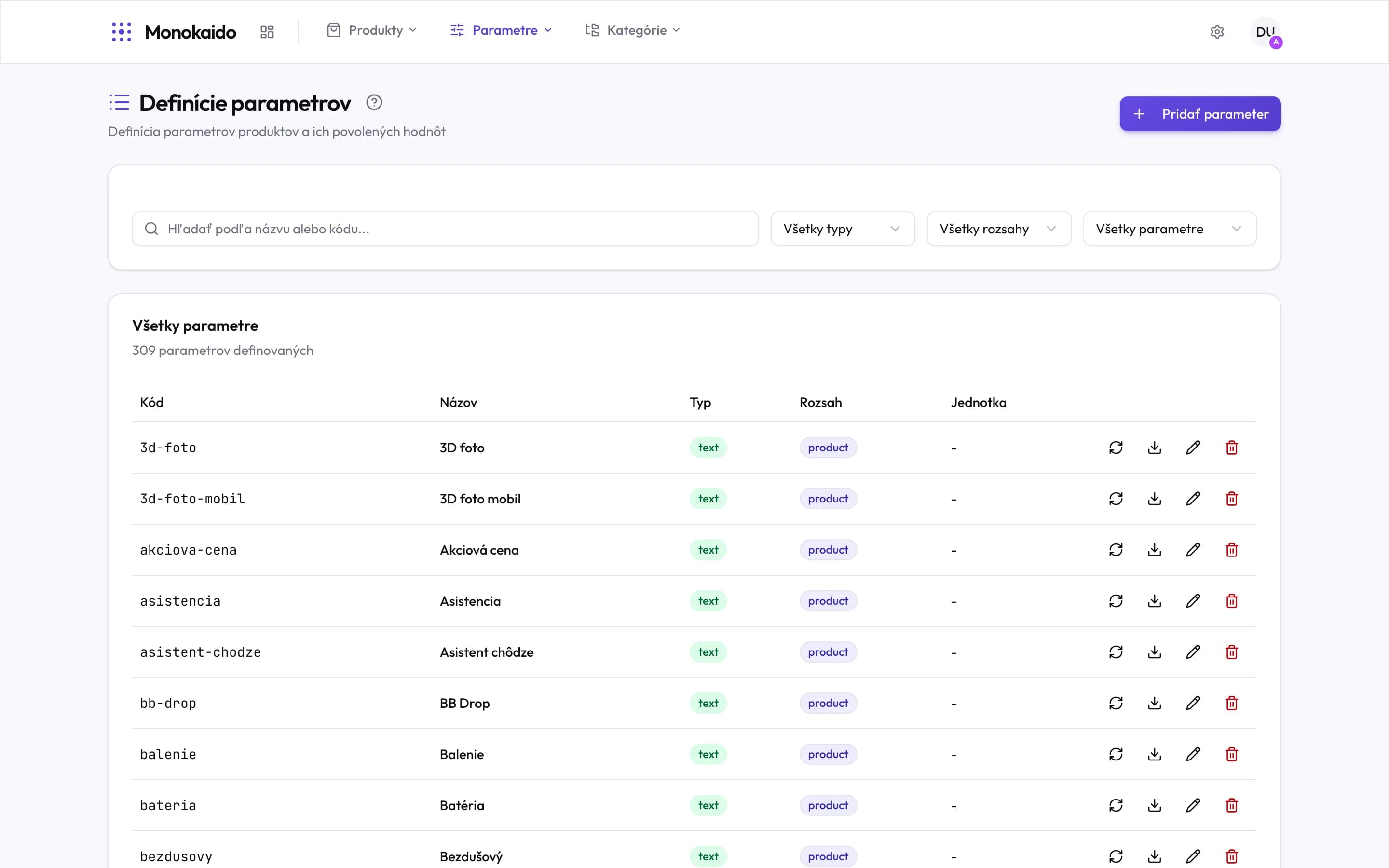
Controls on this screen
- Add parameter — Creates a definition. The code is hard to change later — think it through.
- Search — By name and by code. Indispensable at three hundred parameters.
- Type — Filter by data type.
- Scope — Filter by whether the parameter belongs to a product or a variant.
- Definition count — How many parameters the catalogue knows. It grows with every new vendor.
- Code — The machine identifier. Used in exports, in the API and in templates.
- Name — What a person sees in the catalogue and in the shop.
- Type — The data type — text, number, yes/no, a choice from a list.
- Scope — "product" = a property of the product; "variant" = it differs between variants.
- Unit — mm, kg, W… A dash means a dimensionless parameter.
- Row actions — Recalculate values, export, edit and delete the definition.
What a definition holds
| Field | What it does | Note |
|---|---|---|
| Code | The parameter's machine identifier. | Changing a code breaks the exports and templates that use it. Choose one that will last. |
| Name | The human name. | This is what gets translated into the shop's languages. |
| Type | Text, number, yes/no, or a choice from a list. | A numeric type allows range filtering ("under 5 kg"); a text type does not. |
| Scope | Does the parameter belong to the product, or does it differ between variants? | Colour is usually per variant, packaging weight per product. A wrong scope only shows up in the shop, when the filter does not work. |
| Unit | mm, kg, W and so on. | Shown beside the value and used in conversions. |
| Example values | A comma-separated list of expected values. | Not a constraint — context. |
| Context for the AI | An explanation of what the parameter means. | This is what decides the quality of AI extraction and AI mapping. A parameter called "BB Drop" tells the AI nothing without it. |
Where did 300 parameters come from when I created none?
They appeared during imports — every new name a feed brought and that could be matched has a definition. With several vendors that is a few hundred quickly.
Can I delete a parameter?
Yes, but check first whether a template, an export or a shop filter uses it. When the parameter is the value source of a parameter mapping that is switched on (a feed name's own parameter), the Delete Parameter dialog says so: once it is deleted, its value mappings stop applying and the feed values are unified by the target parameter's rules alone.
What is the difference between “product” and “variant”?
A variant-scoped parameter can hold a different value on every variant — typically colour or size. A product-scoped one has a single value for the whole product.